




By Our Reporter
President Bola Tinubu has assured Nigerians that his administration’s ongoing restructuring of the nation’s security architecture will deliver decisive victories against terrorism, banditry and kidnapping, while expressing confidence that the country’s economy has stabilised and prosperity is on the horizon.
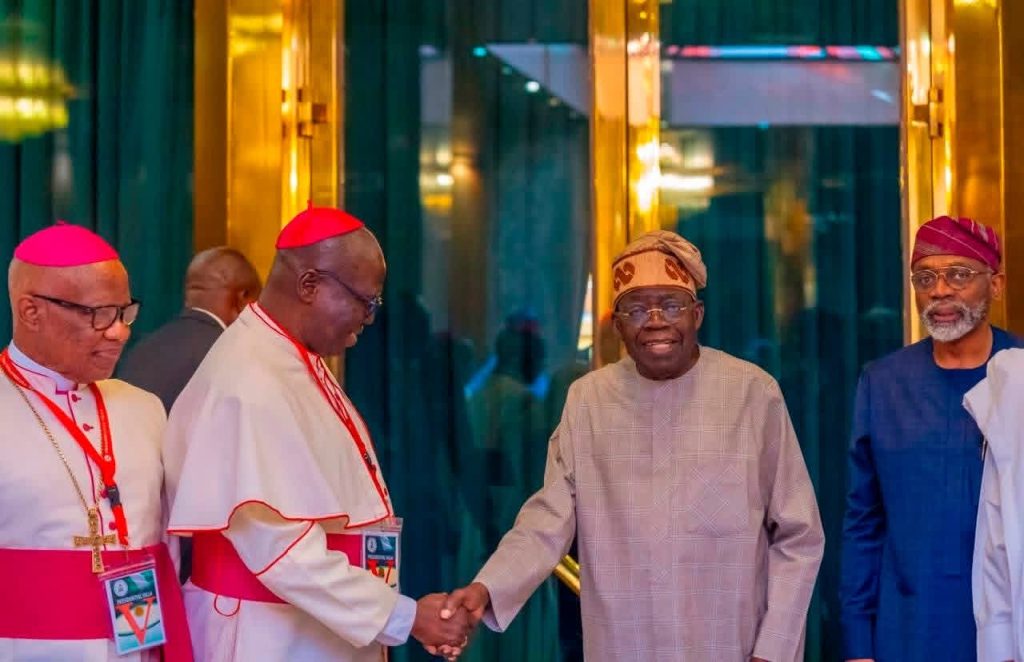
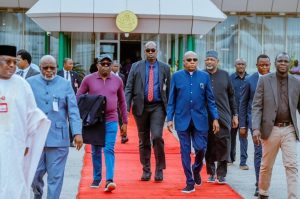
The President gave the assurance on Tuesday while receiving the leadership of the Catholic Bishops’ Conference of Nigeria (CBCN), led by its President, Archbishop of Kaduna, Most Rev. Matthew Ndagoso, at the Presidential Villa, Abuja.
The delegation comprised 19 Catholic bishops and senior clerics, including the Vice President of the CBCN, Archbishop of Lagos, Most Rev. Alfred Martins, the Secretary of the conference and Bishop of Abeokuta, Most Rev. Peter Odetoyinbo, Archbishop Emeritus of Abuja, Cardinal John Onaiyekan, Bishop of Sokoto, Bishop Matthew Kukah, Archbishop of Ibadan, Most Rev. Gabriel Abegunrin, and other church leaders.
President Tinubu said the Federal Government is confronting insecurity through enhanced intelligence gathering, the restructuring and repositioning of security institutions, improved logistics and better welfare for security personnel.
He disclosed that he had approved the expansion of the Armed Forces, alongside the procurement of more military equipment and the construction of additional barracks to strengthen the nation’s security capacity.
“We don’t have another country but Nigeria. We will defeat terrorism. I have just approved the expansion of the Armed Forces. We are getting more equipment and building new barracks,” the President said.
He also urged religious leaders to continue preaching peace and support government efforts to end insurgency and violent crimes across the country.
On the economy, Tinubu maintained that his administration had rescued Nigeria from financial instability and laid the foundation for sustainable growth.
“The country has been placed on a sound footing. The economy has recovered. The alarm for bankruptcy and the dark tunnel of uncertainty that we met has been reversed. This government has stabilised, and there is prosperity on the horizon. Life is improving,” he said.
The President highlighted interventions such as the Nigerian Education Loan Fund (NELFUND), describing education as a critical tool for reducing poverty and creating opportunities for young Nigerians.
He also noted that universities across the country now enjoy uninterrupted academic calendars, pointing out that the absence of prolonged industrial actions by the Academic Staff Union of Universities (ASUU) has contributed to stability in the education sector.
On preparations for the 2027 general elections, Tinubu insisted that the Independent National Electoral Commission (INEC) has remained neutral.
“The opportunities are equal. INEC is neutral. They have never intimidated anyone. If political opponents are crying wolf, maybe they are afraid of their own shadows and the uncertainty in the companies they keep, not me,” he said.
The President added that state governors have the constitutional authority to determine the return of mission schools, recalling that his administration returned mission schools while serving as Governor of Lagos State.
Earlier, the President of the Catholic Bishops’ Conference of Nigeria, Most Rev. Matthew Ndagoso, commended President Tinubu for the warm reception accorded to the Holy See’s Secretary for Relations with States and International Organisations, Archbishop Paul Gallagher, during the recent celebration of 50 years of diplomatic relations between Nigeria and the Vatican.
Ndagoso, however, raised concerns over insecurity, poverty, access to quality tertiary education, the need to sustain democratic gains and the conduct of credible elections.
He urged the President to facilitate the return of mission schools where appropriate, ensure fairness in the provision of places of worship across the country and guarantee free, fair and credible elections in 2027.
“As a man who risked so much in the struggle for the return of democratic rule during the military era, your greatest legacy would be the strengthening of our democratic institutions,” the Archbishop said.
The meeting formed part of ongoing engagements between the Federal Government and religious leaders on national development, security, education and democratic governance.