




By Jelili Gbadamosi
Abdel Fattah al-Sisi, Egyptian President has ordered an urgent investigation into a train collision in Giza that killed four passengers and left 88 others injured.
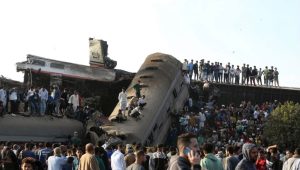
The accident occurred on Sunday in the Al-Ayyat area, south of Cairo, when a train travelling from Giza to Fayoum rammed into the rear of another train heading from Cairo to Aswan.
Egypt’s railway authority confirmed that the collision caused several carriages to derail, while the Ministry of Health said four people had died and 88 others were receiving treatment at hospitals across the Giza area.
Earlier reports by state-owned media put the number of injured passengers at 120, although the severity of their injuries was not immediately established.
Reacting to the incident, Sisi said he was following developments with great concern and had directed relevant authorities to investigate the circumstances surrounding the crash.
He also ordered that anyone found responsible for negligence should be held accountable.
Emergency responders deployed cranes and other equipment to remove the wreckage and rescue victims trapped in the damaged coaches.
AFP journalists at the scene reported that several carriages had overturned, while sections of the trains were severely damaged by the impact.
The collision has renewed concerns over railway safety in Egypt, where the rail network has recorded several deadly accidents over the years.
The Al-Ayyat area was also the scene of one of the country’s worst railway disasters in 2002, when a fire engulfed a passenger train travelling south of Cairo, killing more than 370 people.
Further train crashes in the area in 2009 also claimed dozens of lives.
Egypt, with a population of about 110 million, relies heavily on its railway system, one of the largest in Africa.
Although the government has invested billions of dollars in transport infrastructure over the past decade, including highways and high-speed rail projects, significant parts of the country’s ageing railway network are yet to be fully modernised.