





By Ikugbadi Oluwasegun
The federal government has officially commenced the nationwide digital registration of births and deaths under its Electronic Civil Registration and Vital Statistics, (E-CRVS) system.
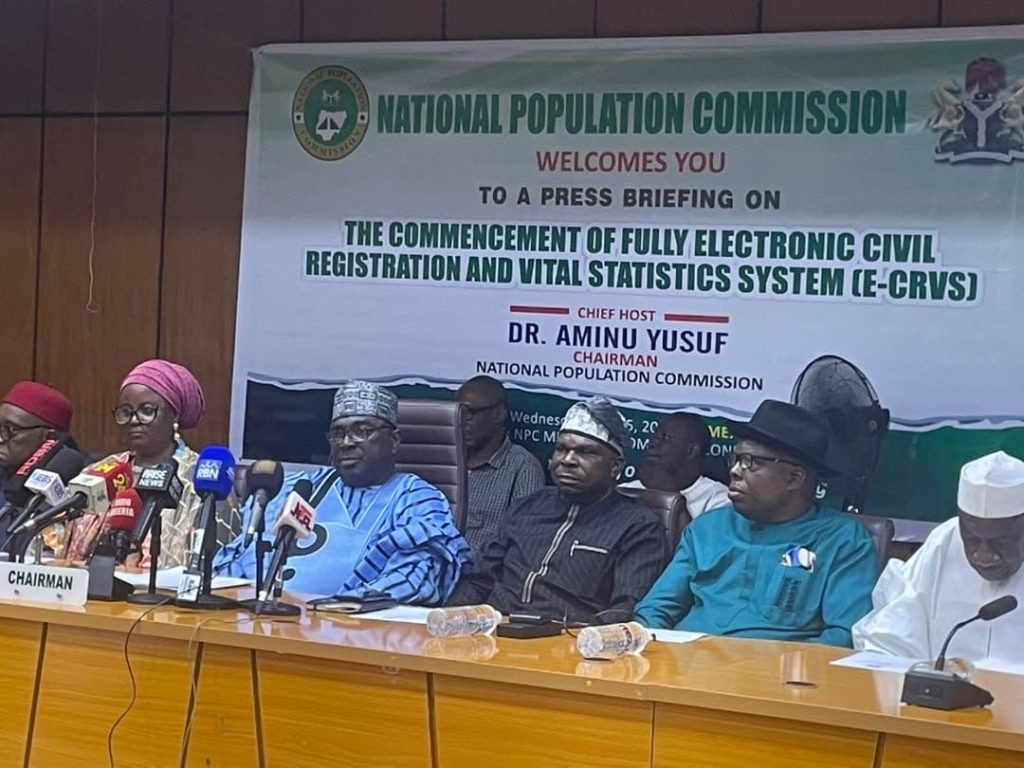
Aminu Yusuf, Chairman of National Population Commission, announced this at a press briefing in Abuja, describing the initiative as a major milestone in Nigeria’s drive to modernize civil registration and improve the country’s vital statistics.
According to him, the new VitalReg platform became fully operational across the 36 states and the Federal Capital Territory on July 1, 2026.
He said the digital system is designed to ensure that every birth and death in Nigeria is accurately captured through a secure and technology-driven registration process.
Dr. Yusuf noted that Nigeria records an estimated five million births every year, but only about 57 percent are officially registered, while death registration remains below 20 percent. He said the gap has affected national planning and denied many Nigerians access to legal identity.
To improve coverage, the Commission says it has established more than four thousand registration centres across the country’s 774 local government areas, with plans to increase the number to about eight thousand.
The NPC Chairman explained that the VitalReg platform will provide faster registration services, round-the-clock online access, digital certificate issuance where applicable, reduced paperwork, improved data accuracy, and a more secure national database.
He added that the platform is integrated with Nigeria’s digital identity ecosystem and aligns with the Federal Government’s digital transformation agenda.
The Commission also announced a partnership involving the Association of Local Governments of Nigeria, the National Identity Management Commission, UNICEF, and Barnksforte Technologies Limited to decentralize birth registration and improve access to registration services at the community level.
While announcing a review of fees for selected administrative services such as record modifications, certificate reissuance, attestations, and verification requests, Dr. Yusuf assured Nigerians that birth registration and birth notification services remain highly subsidized to support universal registration.
He called on state governments, local councils, healthcare institutions, traditional and religious leaders, civil society organisations, development partners, and the media to support the successful implementation of the digital registration system.
Dr. Yusuf reaffirmed the Commission’s commitment to ensuring that every Nigerian is registered from birth, saying the initiative will strengthen national planning, improve governance, and guarantee legal identity for all citizens.