




By Tosin Adesile
The International Press Centre (IPC) has urged journalists, editors and online publishers to prioritise citizens’ concerns, strengthen fact-checking and hold political leaders accountable as Nigeria prepares for the 2027 general elections.
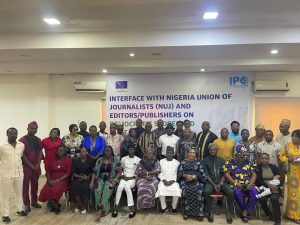
Dr. Lanre Arogundade, Executive Director of IPC, made the call in his welcome remarks at a one-day interface with the Nigerian Union of Journalists (NUJ), editors and publishers on professional and democratic accountability journalism ahead of the 2027 general elections in Abuja.
Arogundade, who was represented at the event, said the media must move beyond event-driven political coverage to more substantive, issue-based and citizen-centred reporting that reflects the aspirations and expectations of Nigerians.
He noted that elections should not be limited to political campaigns, rallies, candidates and the announcement of results, but should also provide opportunities for citizens to express their concerns and make informed decisions about the country’s future.
According to him, the media has a responsibility to facilitate informed public discourse, scrutinise political promises, hold public officials accountable and ensure that citizens’ voices are adequately represented in the democratic process.
He identified the economy, education, healthcare, security, employment and infrastructure as critical issues that should receive greater attention in election reporting, while urging journalists to give visibility to women, young people, persons with disabilities and other underrepresented groups.
Arogundade also cautioned against sensationalism, unverified claims, inflammatory rhetoric and the unchecked spread of misinformation and disinformation, warning that such practices could undermine public confidence, deepen social divisions and weaken democratic institutions.
He stressed that fact-checking and verification must become integral to responsible electoral journalism, particularly with the growing influence of digital platforms and the increasing speed at which manipulated content and divisive narratives circulate.
The IPC executive director further called for the protection of journalists’ safety and professional independence, insisting that media practitioners should be able to perform their legitimate duties without intimidation, harassment or unlawful interference.
In a related presentation, Dr. Sarah Gambo of the Department of Broadcasting, Film and Multimedia Studies, University of Abuja, urged journalists to prioritise citizens’ concerns and strengthen accountability reporting ahead of the 2027 general elections.
Gambo made the call while delivering a lecture titled, “2027 General Election in the Context of Democratic and Accountability Reporting: Scanning the Electoral Environment and Reporting Citizens’ Priority Concerns.”
She examined the role of the media in assessing the electoral environment and ensuring that citizens’ priority concerns remain central to election coverage.
The presentation provided an opportunity for journalists, online editors, and publishers to reflect on their responsibilities in promoting democratic accountability through professional, balanced, and responsible reporting ahead of the polls.
The engagement also featured discussions on the changing information environment, the challenges of misinformation, and the need for journalists to strengthen their capacity to verify politically sensitive information before publication.
The one-day interface was organised by the International Press Centre under Component 4 (Support to Media) of the European Union Support to Democratic Governance in Nigeria (EU-SDGN III) Programme, with the support of the European Union.
The IPC also acknowledged the support of the NUJ FCT Council, led by Comrade Grace Ike, in facilitating the engagement.
Another resource person at the interface was Mr Ahmad Aluko, a researcher and information disorder analyst who spoke on Why fact-checking matters and the role of Journalist ahead of election.
The engagement forms part of broader efforts to strengthen media participation in democratic governance and improve the quality of electoral reporting in Nigeria ahead of the 2027 general elections.