




By our Reporter
President Bola Ahmed Tinubu on Tuesday called for a comprehensive reform of the global financial architecture to support Africa’s industrialisation and economic growth, saying the current system continues to disadvantage developing economies across the continent.
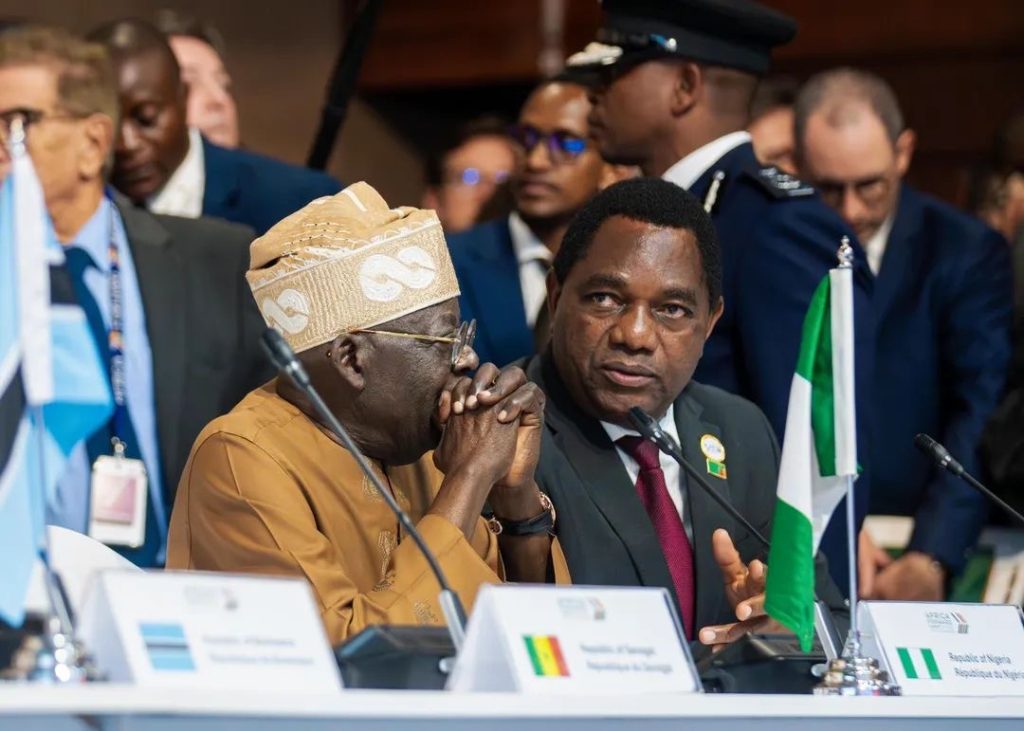
Tinubu made the call while leading Nigeria’s delegation to the Africa Forward Summit held at the Kenyatta International Convention Centre in Nairobi, Kenya.
The summit, co-hosted by Kenyan President William Ruto and French President Emmanuel Macron, brought together leaders and senior officials from over 30 countries across Africa and beyond to discuss economic transformation, trade, investment, industrialisation and regional cooperation.
Other speakers at the summit included United Nations Secretary-General Antonio Guterres and Chairman of the African Union Commission, Mahamoud Ali Youssouf.
During his address, President Tinubu said Africa’s industrial progress had been hindered by a global financial system that denies the continent access to affordable capital while encouraging dependence on raw material exports.
“Despite decades of independence, Africa’s share of global manufacturing value added remains below two per cent. We export raw minerals, crude oil and agricultural commodities, while importing processed goods at a premium,” he said.
The President argued that the international financial architecture has continued to impose structural disadvantages on African economies through high borrowing costs and restrictive financial conditions.
“The international financial architecture, as currently constituted, is an instrument of industrial disarmament for Africa,” Tinubu declared.
He noted that Nigeria had undertaken difficult but necessary economic reforms, including fuel subsidy removal, exchange rate unification, banking sector recapitalisation and reforms that helped the country exit the Financial Action Task Force grey list.
According to him, the reforms have strengthened Nigeria’s economic outlook, with the country projected to achieve a declining debt-to-GDP ratio of 32.3 per cent in 2026 and external reserves of about $45.5 billion.
However, Tinubu lamented that excessive debt servicing continues to drain resources needed for industrial growth and infrastructure development.
“In 2026, Nigeria will spend about $11.6 billion on debt servicing. Every dollar used to pay punitive interest rates is a dollar not invested in steel production, agro-processing, power supply, digital industries or the training of young Nigerian engineers,” he said.
The President maintained that Africa was not asking for charity but for fair access to financing capable of driving industrialisation, manufacturing and economic competitiveness.
“Nigeria is demanding a financial system that intentionally enables Africa to industrialise, refine its own crude oil, process its minerals and manufacture its own products competitively,” he added.
Tinubu also highlighted Nigeria’s commitment to developing the blue economy, pledging stronger regional maritime cooperation through Nigeria’s Deep Blue Project to improve security and attract investment in the Gulf of Guinea.
According to him, Nigeria is ready to share its maritime intelligence infrastructure with willing regional partners to strengthen ocean governance and maritime security.
“Secure sea lanes, predictable regulation and functional courts are the conditions that attract private capital,” he said.
On migration and security, the President stressed the need to address the root causes of irregular migration by creating jobs, expanding economic opportunities and improving living conditions across African countries.
He urged international partners to dedicate part of Official Development Assistance to programmes capable of reducing poverty, unemployment and desperation among young Africans.
President Tinubu also called for stronger global migration governance and deeper cooperation between African institutions and international organisations.
On the sidelines of the summit, Tinubu held bilateral talks with Madagascar’s President, Michael Randrianirina, and also met with the President of the Confederation of African Football, Dr Patrice Motsepe, where he reiterated Nigeria’s readiness to host the 2026 CAF Awards.
The Nigerian delegation included Minister of Foreign Affairs, Bianca Odumegwu-Ojukwu; Minister of Agriculture and Food Security, Abubakar Kyari; Minister of Marine and Blue Economy, Adegboyega Oyetola; Minister of Industry, Trade and Investment, Dr Jumoke Oduwole; Minister of Communications, Innovation and Digital Economy, Bosun Tijani, among others.
Business leaders at the summit included President of Dangote Group, Aliko Dangote; Chairman of BUA Group, Abdulsamad Rabiu; Chairman of UBA Group, Tony Elumelu; and Chairman of Access Holdings Plc, Aigboje Aig-Imoukhuede.