




By our Reporter
The Independent National Electoral Commission (INEC), in collaboration with the Development Alternatives Incorporated (DAI) and the Nigerian Guild of Editors (NGE), on Monday held a strategic workshop for media executives in Abuja, where INEC Chairman, Prof. Joash Amupitan, SAN, disclosed that Nigeria’s National Register of Voters has risen to more than 103 million ahead of the 2027 general elections.
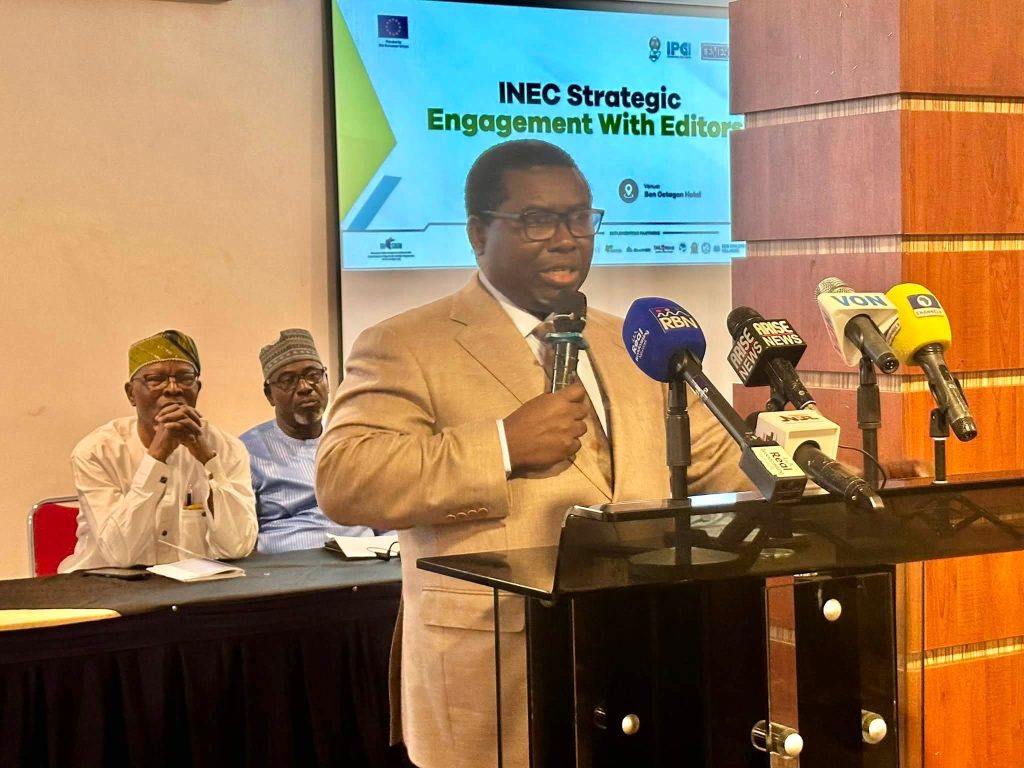
The workshop, held at BON Hotel Octagon, Jahi District, Abuja, with the theme, “Strengthening Democracy Through Partnership Among Editors, Civil Society and Electoral Institutions,” focused on strengthening collaboration between the electoral management body, the media and civil society ahead of the 2027 elections.
INEC Chairman said the Commission’s three-phase Continuous Voter Registration (CVR) exercise had attracted more than 10.6 million new applicants, while the public display of the Preliminary Register for claims and objections had been completed.
He added that the Commission had also completed the final Automated Biometric Identification System (ABIS) cleanup of the register.
The INEC Chairman used the forum to announce that the nationwide collection of Permanent Voter Cards (PVCs) will commence on Friday, October 9, 2026, urging eligible citizens to participate in the process.
According to him, the disclosure was particularly important as the country approaches the 2027 general elections, with INEC working to ensure that the electoral process is transparent, technology-driven and credible.
He said the Commission was committed to continuously improving the Bimodal Voter Accreditation System (BVAS) and the INEC Result Viewing Portal (IReV) to ensure that every valid vote counts and is seen to count.
The Chairman also identified public trust as the ultimate determinant of electoral credibility, stressing that operational efficiency by INEC alone could not guarantee democratic stability.
“The ultimate arbiter of electoral integrity is public trust,” Amupitan said.
He called for a stronger partnership between INEC, editors, civil society organisations and other stakeholders, saying the Commission was prepared to listen to editorial concerns, address operational challenges and provide timely information to prevent misinformation from filling communication gaps.
Amupitan urged newsrooms to establish digital fact-verification desks and pledged that INEC would provide editors with direct access to verify field incidents, logistical developments and security reports in real time.
He further proposed a sustained editorial feedback mechanism between INEC and the Nigerian Guild of Editors to review operational progress and resolve emerging challenges throughout the 2027 election cycle.
Earlier, President of the Nigerian Guild of Editors, Mr Eze Anaba, said the workshop was timely given the country’s proximity to another general election.
Anaba said elections were not merely about casting ballots but about citizens having confidence that their votes would count and that the institutions conducting elections would act fairly and professionally.
He urged editors to uphold accuracy, fairness, balance and public interest in electoral reporting, while calling for stronger access to credible and timely information from INEC
Director Voter Education and Publicity Department, Mrs Victoria Eta-Messi, in her goodwill message identified misinformation and disinformation as major factors contributing to declining citizen participation.
She urged media organisations to support INEC by ensuring that accurate and timely information reached citizens, particularly as the Commission prepares for the commencement of PVC collection.
DAI Team Leader, Rudolf Elbling, said credible elections depended not only on effective electoral administration but also on professional, ethical and fact-based journalism.
He identified electoral integrity, election technology, security of journalists and voters, and information disorder as some of the major challenges confronting the media ahead of 2027.
Executive Director of the Centre for Media and Society(CEMESO), Dr Akin Akingbulu, said Nigeria was at a critical point in its democratic journey, with the 2027 elections approaching and the collection of Permanent Voter Cards scheduled to begin within days.
He noted that electoral information was already shaping public discourse across newspapers, radio, television and digital platforms.
Akingbulu said editors were not defined merely bytheir positions but by the responsibility they carried as stewards of the electoral information ecosystem.
Referring to an earlier charge to editors to verifyrigorously, beware of deepfakes and avoid publishing unofficial results, he declared:
“Verification is a two-way street.”
“Verify before you amplify.”
Executive Director of the International PressCentre (IPC), Mr Lanre Arogundade, said electoral contestation went beyond campaigns and votingto include political interests, information battles and citizens’ perceptions of electoral actors.
He warned that the political economy of themedia could affect the ability of newsrooms to report elections impartially.
Opening the strategic session, INEC National Commissioner and Chairman of the Information andVoter Education Committee (IVEC), Mal. Mohammed Haruna, said the Commission had conducted aseries of elections under its current leadership, including the Anambra governorship election, FCT Area Council elections, Ekiti and Osun governorship elections, as well as several legislative bye-elections.
He also noted that INEC had monitored the primariesof the country’s 22 political parties for the 2027 general elections, including nominations arising from the creation of new court-ordered constituencies.
Haruna said the Commission’s elections had progressively improved, describing the Osungovernorship election as widely adjudged themost successful so far.
Chief Press Secretary to the INEC Chairman, Mr Adedayo Oketola, outlined three broadobjectives of the strategic workshop.
The first, he said, was to rebuild institutional trust through open dialogue by establishing atransparent two-way communication channel between INEC leadership and media gatekeepers
The second objective was to combat information disorder and strengthen fact verification.
Oketola said the Commission wanted to establish seamless 24-hour fact-verification loops between newsrooms and INEC so that speed would not come at the expense of accuracy.
The third objective was to promote shared democratic responsibility among the media, civil society andelectoral institutions through ethical gatekeeping, conflict-sensitive reporting and civic enlightenment.
Following the opening ceremony, participants moved into technical sessions examining various dimensions of electoral reporting and democratic participation.
The sessions, facilitated by Dr. Tony Onyima, Prof. Lai Olurode, Lobe Hvass, Mr. Lanre Idowu, and Mr. Lanre Arogundade, focused on strengthening Nigeria’s electoral integrity through responsible and balanced reporting, effective enforcement of electoral laws, election technology, citizenship, and inclusive governance. They also addressed the future of Nigerian children, electoral safety and prosecution of electoral offences, as well as combating misinformation and information disorder through fact-checking and ethical gatekeeping in election reporting.